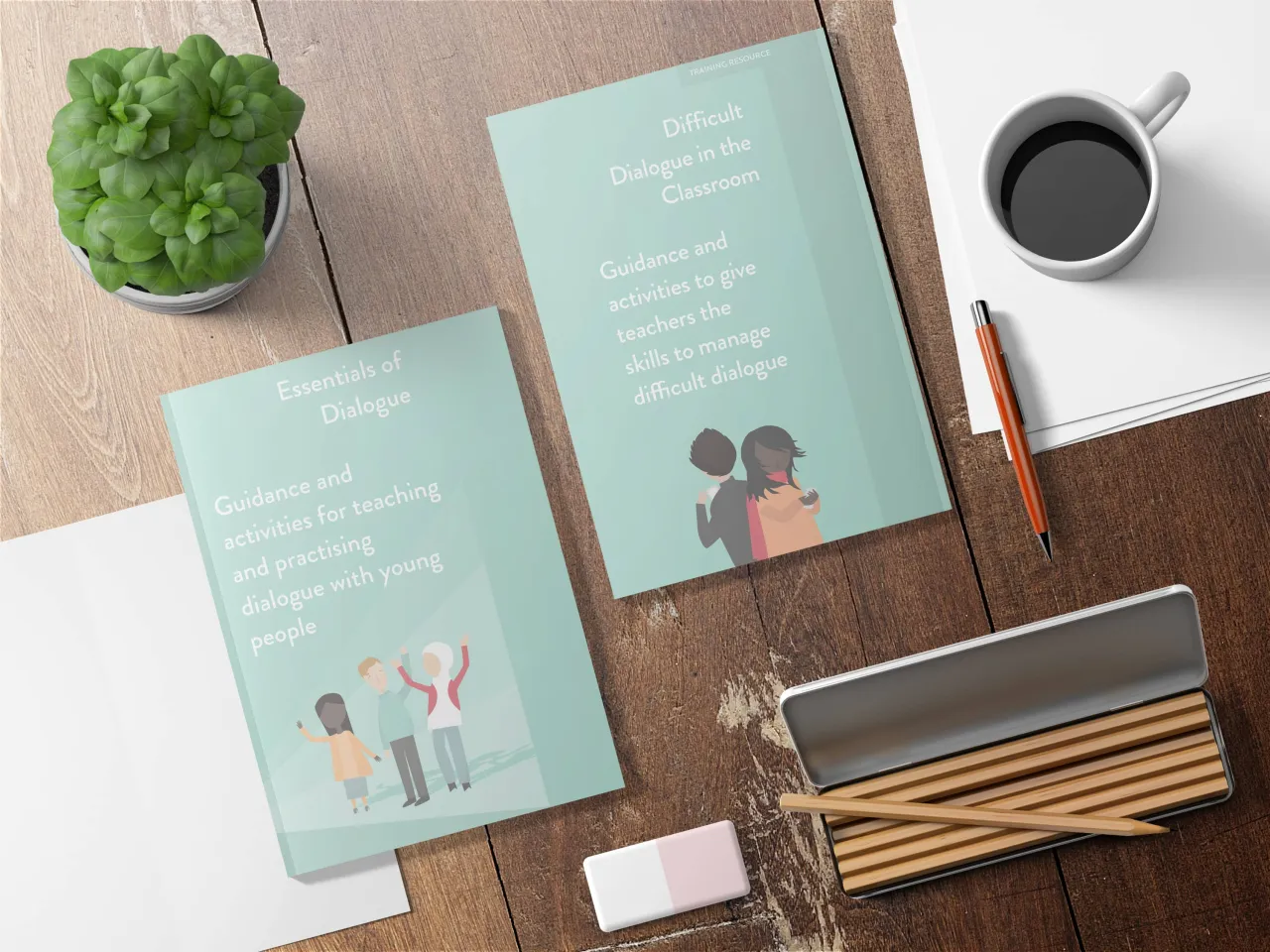
Resource
Teacher Companion Guide

Explore the guide
Discover this interactive, student-centered learning journey to support young people ages 13-17 in developing the skills of dialogue.
The Ultimate Dialogue Adventure (UDA) is an immersive and fun way for young people to learn and practise the skills of dialogue, explore different perspectives and global topics, and build intercultural connections with peers from all over the world. Through this fun and interactive game, they will be awarded badges and certificates for completing learning on different topics, earn points (XP) on their way to becoming dialogue masters and discover ways in which they can use dialogue in real life. The platform is designed for 13-17-year-olds and will enable young people to:
- Be part of a safe and moderated online global community, that connects learners around the world outside of the classroom.
- Be able to learn the key skills of dialogue, which are: critical thinking, active listening, global communication, questioning and reflection.
- Improve their communication skills and enhance their English language skills in a way that is engaging and informative.
- Share their perspectives and learn from international peers on a range of global issues, including the Rights of Girls and Women, Climate Change, Social Media and Fake News, Hate Speech Online, Identity and Belonging and many more.
To participate in the UDA, all learners need is an internet enabled device - laptop/ desktop, mobile, or tablet. The UDA is designed to be accessible and inclusive.
If you want to learn more, visit the Frequently Asked Questions for teachers.
Review the learning outcomes for using the Ultimate Dialogue Adventure and the core skills that students will develop throughout the platform.
Learning Outcomes
By participating in the Ultimate Dialogue Adventure young people will achieve learning outcomes that support their development in the five core skills of dialogue, increase their global knowledge and promote positive and inclusive attitudes.
- Understand the five core skills of dialogue - global communication, active listening, critical thinking, asking questions, and reflection as foundational elements for becoming an active global citizen by communicating effectively across cultures and backgrounds.
- Practice key actions that exemplify skills of dialogue - appreciating, sharing, asking, challenging, and reflecting during dialogue in the Generation Global community to explore global issues, build confidence, and better understand the experiences and perspectives of others.
- Gain greater knowledge of different cultures and values through the experience of interactive learning modules and online dialogue with peers to support openmindedness and diversity.
- Develop intercultural relationships with peers from around the world, contributing to a cohesive and collaborative online community.
- Demonstrate more positive and inclusive attitudes when communicating across difference to show appreciation for diversity.
Core Skills Framework
Read and use the Core Skills Framework to support students to develop specific objectives related to each skill and key action in the Ultimate Dialogue Adventure.
You can download a full copy of this framework by taking the course Introduction to Dialogue, available in the "Professional Development" section of the Teacher Portal.
Skill: Global Communication
Definition: The ability to speak authentically when communicating across cultures by sharing personal stories ,experiences, values, and perspectives and respectfully challenging perspectives and opinions when in disagreement
Key Actions: Sharing, Challenging
Skills Outcome
Share personal stories and experiences with confidence in an honest and open manner to promote understanding.
Learning Objectives
Students are able to use 'I' statements to share about their own personal experiences and perspectives and avoid speaking on behalf of other individuals and groups.
'I Can' Statements of development
- I share basic information about myself such as my interests, daily life, or opinions.
- I share more personal information about myself and my experiences using “I” language.
- I talk about my own beliefs and experiences giving examples and using feeling words to say how I feel.
- I share about my personal experiences in detail, explaining how they exist in my life and why they are important.
- I identify and talk about the complexities of the issues/my experiences and ensure that what I am sharing is understood clearly by others.
Learning Objectives
Students provide clear and detailed descriptions about themselves (including their identity and communities they feel they belong to), their perspectives and experiences, and how they relate to the topic.
Learning Objectives
Students are able to explain personal values, meanings, and the importance of their own experiences when engaging with individuals and groups from different cultures and backgrounds.
Skills Outcome
Challenge the perspectives of others with respectful disagreement.
Learning Objectives
Students can pose challenging questions or statements using language that is unbiased and does not denigrate themselves or others.
'I Can' Statements of development
- I notice different points of view or opinions to my own.
- I make challenging statements or questions to participate in complex conversations.
- I show I am willing to disagree and take responsibility for my perspectives by using 'I' statements like 'I believe' or 'I think'.
- I respond to other statements or questions with a challenge that is respectful in tone, uses clear language and sentence starters like 'Thank you, have you considered…' or 'In my opinion'.
- I intentionally create opportunities to challenge what I have written (e.g. asking 'Do you agree or disagree? I'd love to learn different perspectives at the end of a post).
Learning Objectives
Students can respectfully challenge another perspective or idea when in disagreement by using supportive sentence starters such as 'In my opinion' or 'Thank you for your perspective' and 'I think' or 'I feel' statements.
Skill: Active Listening
Definition: The ability to listen to others, understand what they are saying, and show empathy and recognition
Key Actions: Appreciating / Acknowledging
Skills Outcome
Appreciate and acknowledge the perspectives of others, providing feedback in various forms (written explanation, tone, body language) to demonstrate listening.
Learning Objectives
Students can demonstrate they are listening to others by acknowledging their contributions with gestures or thanks and responding appropriately to what is being shared.
'I Can' Statements of development
- I show that I appreciate what my peers say by liking a post or nodding when they speak.
- I say what I really like about what someone has said and give them feedback.
- I reference something specific someone has said and build on it to go deeper in the conversation.
- I explain why someone else's post is valuable for the dialogue and how it helped my understanding.
- I provide detailed feedback explaining how I value someone else's the post, specifically elements that make it a good statement or questions for dialogue, how it has inspired or impacted me.
Learning Objectives
Students are able to logically build on what is being said in order to go deeper in a dialogue and build a dialogic thread.
Learning Objectives
Students are able to provide descriptive feedback about why what they are reading/hearing is of value to them and the dialogue.
Skill: Critical Thinking
Definition: Analyse knowledge about the world, multiple perspectives, and identity, including what influences who we are, how we think and what we believe.
Key Actions: Analysing
Skills Outcome
Analyse knowledge about the world, multiple perspectives, and identity, including what influences who we are, how we think and what we believe.
Learning Objectives
Students are able to analyse a topic or issue and identify diverse and multiple perspectives.
'I Can' Statements of development
- I think about a topic or what I hear and state my opinion in response.
- I identify similarities and differences in what I hear or read about a topic and what my peers have shared about their perspective, opinion, or experience.
- I analyse a topic and what I hear or read and identify multiple and diverse perspectives in a dialogue.
- I analyse information on a topic, as well as my own and others' ideas, to understand meaning and the influences that shape the information or personal perspectives.
- I analyse and interpret the complexities of my own identity and others to better understand how I and others relate to a topic and what makes a unique individual.
Learning Objectives
Students are able to analyse what they hear or read by investigating its meanings and the influences that shape it.
Learning Objectives
Students are able to evaluate and interpret the complexity of their own and others individual identities, seeing others as unique individuals, not only as members of the groups to which they belong.
Skill: Questioning
Definition: Construct and ask questions that promote deeper learning about self and others, and explore the topics of dialogue.
Key Actions: Asking
Skills Outcome
Construct and ask questions that promote deeper learning about self and others, and explore the topics of dialogue.
Learning Objectives
Students are able to construct and ask relevant questions to learn about the values, ideas, perspectives and experiences of others.
'I Can' Statements of development
- I ask questions about people's favourite things, hobbies, or interests.
- I ask more open questions that seek clarification and information about lifestyles, communities, opinions, and beliefs.
- I ask my peers questions about their experiences and why those experiences are important to them.
- I ask response questions that cannot be answered with 'yes or no' to build a thread in the dialogue based on what my peers are saying (I don't comment once and stop there).
- I construct questions that include plain language, without assumption or judgement, that prompts the respondent to share in detail about their own experiences.
Learning Objectives
Students are able to prompt respondents to go deeper into the dialogue by constructing questions that cannot be answered with 'yes or no'.
Learning Objectives
Students are able to evaluate their own and other's questions for inherent assumptions and judgments in an effort to construct questions that promote inclusion and diverse perspectives.
Skill: Reflection
Definition: The ability to evaluate and assess our own and others experience of dialogue and the impact it has on our own development
Key Actions: Reflecting
Skills Outcome
Reflect on the experiences of self and others to make connections with different stories and identify opportunities for deeper learning.
Learning Objectives
Students are able to think about the experience of the dialogue and recognize the impact it has had on them and/or the group.
'I Can' Statements of development
- I give thanks for my peer's participation in the dialogue when I am reflecting.
- I reflect on the dialogue and talk about what was said regarding the topic.
- I recall specific details of what was said in the dialogue and how it made me feel or think.
- I say what I learned and note any new ideas or perspectives that came out of the dialogue.
- I form and respond to critical questions about the process of learning, the impact the experience has on myself and others, and think about new ways to move forward and grow.
Learning Objectives
Students can reflect on the experience of dialogue and say what they have learned from others and about themselves, including any ways the dialogue has helped them to shape new perspectives.
Learning Objectives
Students are able to identify any challenges and learning opportunities in the dialogue and how this can further their skills development.
Gaining points (XP) for skills
Students can develop the core skills of dialogue in the written Dialogue Spaces and by participating in video conferences. The more they practise and apply the dialogue skills, the more XP they earn. Each of the Squads below is aligned to the I can statements in the Learning Framework.
Once young people complete the Learning Dojo (introductory topic) on the Ultimate Dialogue Adventure they are free to complete short learning modules on specific global topics where they can then participate in written Dialogue Spaces and video conferences to practise the skills of dialogue.
The list of available topics includes:
- Civic Participation
- Climate Change
- Culture, Beliefs and Values
- Education
- Fake News and Social Media
- Global Citizenship
- Hate Speech Online
- Identity and Belonging
- Rights and Inequalities
- The Rights of Girls and Women
- Wealth and Poverty
If you want to review the content of these interactive topics, please sign into your Teacher Portal.
Video conference quality of dialogue summary
Use this summary to help young people apply the skills of dialogue in a video conference experience.
When young people complete a topic and earn 30 XP in the corresponding written dialogue space they unlock the schedule to book themselves into a video conference on the same topic. Here they have the ability to practise the skills they are developing in spoken dialogue with global peers from all over the world.
The video conference facilitator and the participants will rate the quality of the dialogue at the end of the session. The quality of dialogue rating starts from Encounter through to Advanced. Below are illustrated the different dialogue rating levels.
Encounter
Most participants did not demonstrate dialogue because they may have made assumptions or judgements, did not show curiosity, listen, share about their lives, ask questions, or reflect on the experience.
Engagement
Most participants showed some signs of emerging dialogue through general sharing about their perspectives and social groups, listening with body language, or asking basic questions, yet still had difficulty as a group in forwarding the conversation.
Beginning
The group began to demonstrate dialogue with most participants sharing about personal perspectives and experiences using 'I' language, listening and asking 'Why' questions of each other, and ensuring all voices were heard.
Good
Dialogue was present, and the group shared clear and detailed descriptions about their values and personal experiences, analysed influences and impacts, built questions off each other's responses to go deeper into the dialogue, and owned the flow of the conversation together.
Advanced
The complete experience of the dialogue was owned by the whole group; it was fluid, complex, challenging, and inclusive. All participants shared in detail, asked probing questions, and reflected on what was learned and could be improved for themselves and as a group.
Download summary (98 KB) (PDF, 80.6 KB)
Tips and strategies for a quality experience on the Ultimate Dialogue Adventure
Use these tips and strategies below to support you in making sure your learners have a quality learning experience.
Learn what we are doing to protect and safeguard young people on our platform and throughout our programme.
Explore strategies for integrating the Adventure into your learning community and suggested lesson plans based on different time commitments and level of engagement.
Strategies for using the Ultimate Dialogue Adventure
There are many ways you can integrate the Ultimate Dialogue Adventure into your classroom or learning community, ranging from student-led to co-curricular support.
Extra-curricular
Can be used as an initiation or to enhance clubs outside of class that promote global citizenship, cultural education, communication skills, digital citizenship.
Enrichment activity
Stretch the more able students by having them undertake activities and then research and seek out varied global perceptions and experiences on issues.
Blended learning
Teach specific subjects in class (such as Dialogue skills from the Essentials of Dialogue, Human Rights, Climate Change). Construct critical questions with students and ask them to use them while participating in the topic dialoogue space to help deepen their learning on the subject.
Flipped Classroom
Have students complete a learning module or a topic on their own time. During class time, have students present their experience, engage in a follow up activity, or a dialogue.
Independent learning
We have found that students are more open, honest and have a higher level of participation when their teachers do not have direct oversight; they are more focused on themselves and their peers which makes for better dialogue. Encourage students to participate and report back on their progress, helping them to map how they can increase their skills.
Download strategies as PDF (PDF, 139.56 KB) (140 KB)
Cornerstone Model
To most effectively use the Ultimate Dialogue Adventure to teach young people the skills of dialogue and expand their knowledge on global topics, follow this cornerstone model to make the most out of the learning experience.
- Generation Global fosters three primary learning outcomes for student learning: Skills building, Topic knowledge, and Global connection.
- Using the Generation Global Cornerstone model, educators can plan to integrate our tools and resources into their curriculum or youth programme.
1. Identify the topic
Choose the social or global issue you are teaching and that learners will dialogue about, for example Rights and Inequalities, Climate Change and Global Citizenship. To see the full list of topics, log into your Teacher Portal.
2. Learn Skills
Use small group or whole class activities from the Essentials of Dialogue in class OR encourage learners to register on the Ultimate Dialogue Adventure and participate in the topics online.
3. Participate in dialogue
Book an international video conference or use the written dialogue spaces in the Ultimate Dialogue Adventure or Teacher Portal where learners can experience live interactions and apply skills for intercultural communication on the topic.
4. Debrief the dialogue
Host a whole-class discussion after the dialogue to debrief the learning experience using activities like Dialogue Reflection in chapter 8 of the Essentials of Dialogue.
Levels of engagement
Depending on how much time you have, use this chart to help you decide the best way to include the Ultimate Dialogue Adventure in your learning community.
Educators can use the Ultimate Dialogue Adventure to support learners in meeting these outcomes by choosing the depth of engagement that aligns to their needs.
Engagement
Light
(download lesson plan (PDF, 179.19 KB))
Description
- Introduces core skills and attitudes
- General topic knowledge
- Light interaction with peers
Process
Learning Dojo
+
Topic or Video Conference
+
Debrief
Time
3 hrs
Engagement
Moderate
(download lesson plan (PDF, 159.13 KB))
Description
- Reinforces core skills and attitudes
- Broadens topic knowledge
- Repeated practice with peers
Process
Learning Dojo
+
Topic
+
Written Dialogue
+
Debrief
Time
4.5 hrs
Engagement
Deep
(download lesson plan (PDF, 182.21 KB))
Description
- Refines core skills and attitudes
- Various activity and knowledge sources
- More diverse interaction with peers
Process
Learning Dojo
+
Topic
+
Written Dialogue
+
Video Conference
+
Debrief
Time
5.5 hrs
Consider ways to evaluate student progress to help them identify growth and expand on their dialogue skills and experiences from the Adventure.
Tips to track students' progress
- Have students print their Dashboard page and provide a self-reflection report on their progress and what they can do to improve
- Ask students to engage in peer review using the 'I Can' statements from the online adventure to support each other's development
- Store evidences in a student portfolio for review and to demonstrate their growth at the end of a term
Types of evidence to collect:
Quantitative (evidence from individual students)
Request the following from students:
- Print out and collect number of badges for each learning module
- Print out of students' skills tracker. Use numerical value of Experiential Points (XP) to see to what extent students are practising each skill.
Qualitative (from in-class activities)
- Student self-evaluations of XP levels and written reflections of where they see themselves in their progress (use reflection worksheet)
- Individual or class plans on how to improve the skills of dialogue
- Facilitator notes from classroom video conferences
- Recordings or notes/testimonials from whole class debriefs about the students experience in online adventure (use the WWW/EBI worksheet)
How to assess the evidence:
- Use the framework rubric to determine and review which level each student is in.
- Based on the next level of attainment, choose which actions and activities learners can do in class to develop more effective dialogue skills.
Download tips to track students' progress (PDF, 116.95 KB) (PDF - 117 KB)
WWW/EBI worksheet (PDF, 98.06 KB) (PDF - 99 KB)
Progress reflection worksheet ('I Can' and XP) (PDF, 93.85 KB) (PDF - 94 KB)
Topic:
Introduction to Dialogue
Description:
Students will learn about how dialogue is different from other modes of communication, and why this is important. They will also understand the five core skills of dialogue and how these translate into specific actions while participating in a dialogue. Lastly, students will explore key elements for building and participating in the Generation Global online community.
Module:
What is dialogue?
Time:
15 min
Topic:
Introduction to Dialogue
Description:
Students will learn about how dialogue is different from other modes of communication, and why this is important. They will also understand the five core skills of dialogue and how these translate into specific actions while participating in a dialogue. Lastly, students will explore key elements for building and participating in the Generation Global online community.
Module:
Core Skills of Dialogue
Time:
20-30 min
Topic:
Introduction to Dialogue
Description:
Students will learn about how dialogue is different from other modes of communication, and why this is important. They will also understand the five core skills of dialogue and how these translate into specific actions while participating in a dialogue. Lastly, students will explore key elements for building and participating in the Generation Global online community.
Module:
Creating Community
Time:
20-30 min
Topic:
Education
Description:
Students will reflect on the nature and purpose of education and their own experiences of schooling, including in the time of global pandemic. They will also explore multiple perspectives and experiences of schooling and re-think how they view their own and others'.
Module:
More than a building
Time:
5-10 min
Topic:
Education
Description:
Students will reflect on the nature and purpose of education and their own experiences of schooling, including in the time of global pandemic. They will also explore multiple perspectives and experiences of schooling and re-think how they view their own and others'.
Module:
Education: a right or privilege?
Time:
5-10 min
Topic:
Education
Description:
Students will reflect on the nature and purpose of education and their own experiences of schooling, including in the time of global pandemic. They will also explore multiple perspectives and experiences of schooling and re-think how they view their own and others'.
Module:
Education in the time of Covid-19
Time:
5-10 min
Topic:
Fake News and Social Media
Description:
Students will be introduced to fake news and social media to analyse what fake news and misinformation is and how to combat it. They will reflect on the value of truth, including how true we are with online identity. Students will think about experiences had with fake news and what to share with global peers on the issue.
Module:
What is Fake News and how do I spot it?
Time:
5-10 min
Topic:
Fake News and Social Media
Description:
Students will be introduced to fake news and social media to analyse what fake news and misinformation is and how to combat it. They will reflect on the value of truth, including how true we are with online identity. Students will think about experiences had with fake news and what to share with global peers on the issue.
Module:
How important is truth?
Time:
5-10 min
Topic:
Fake News and Social Media
Description:
Students will be introduced to fake news and social media to analyse what fake news and misinformation is and how to combat it. They will reflect on the value of truth, including how true we are with online identity. Students will think about experiences had with fake news and what to share with global peers on the issue.
Module:
Fake news in the time of Covid19
Time:
5-10 min
Topic:
Rights of Girls and Women
Description:
Students will listen to and identify the experiences of girls and women. They will connect their own experiences to what is heard and seen about the rights of girls and women to share stories in a dialogue. Students will be introduced to gender inequality and will critically reflect on its impact in the world and in their communities. Students will construct questions for a dialogue about this issue in the time of crisis.
Module:
One girl's story
Time:
5-10 min
Topic:
Rights of Girls and Women
Description:
Students will listen to and identify the experiences of girls and women. They will connect their own experiences to what is heard and seen about the rights of girls and women to share stories in a dialogue. Students will be introduced to gender inequality and will critically reflect on its impact in the world and in their communities. Students will construct questions for a dialogue about this issue in the time of crisis.
Module:
Facts about girls and women's rights
Time:
5-10 min
Topic:
Rights of Girls and Women
Description:
Students will listen to and identify the experiences of girls and women. They will connect their own experiences to what is heard and seen about the rights of girls and women to share stories in a dialogue. Students will be introduced to gender inequality and will critically reflect on its impact in the world and in their communities. Students will construct questions for a dialogue about this issue in the time of crisis.
Module:
The impact of gender inequality
Time:
5-10 min
Topic:
Rights of Girls and Women
Description:
Students will listen to and identify the experiences of girls and women. They will connect their own experiences to what is heard and seen about the rights of girls and women to share stories in a dialogue. Students will be introduced to gender inequality and will critically reflect on its impact in the world and in their communities. Students will construct questions for a dialogue about this issue in the time of crisis.
Module:
Issues in our current reality
Time:
5-10 min
Topic:
Climate Change
Description:
Students will be introduced to concepts of climate change and will investigate what it is and what causes it. They will identify personal stories in their own communities to share with peers. Students will practice empathy by making connections with people's stories and experiences. They will also construct questions for deeper knowledge and understanding during dialogue about climate change.
Module:
What is climate change?
Time:
5-10 min
Topic:
Climate Change
Description:
Students will be introduced to concepts of climate change and will investigate what it is and what causes it. They will identify personal stories in their own communities to share with peers. Students will practice empathy by making connections with people's stories and experiences. They will also construct questions for deeper knowledge and understanding during dialogue about climate change.
Module:
Stories of impact
Time:
5-10 min
Topic:
Climate Change
Description:
Students will be introduced to concepts of climate change and will investigate what it is and what causes it. They will identify personal stories in their own communities to share with peers. Students will practice empathy by making connections with people's stories and experiences. They will also construct questions for deeper knowledge and understanding during dialogue about climate change.
Module:
Dialogue for change
Time:
5-10 min
Topic:
Climate Change
Description:
Students will be introduced to concepts of climate change and will investigate what it is and what causes it. They will identify personal stories in their own communities to share with peers. Students will practice empathy by making connections with people's stories and experiences. They will also construct questions for deeper knowledge and understanding during dialogue about climate change.
Module:
Climate change and Coronavirus
Time:
5-10 min
Topic:
Culture, Beliefs and Values
Description:
Students will be introduced to how culture, beliefs and values shape identity and community. They will listen to and identify others' values and beliefs and critically reflect on their own communities' values and beliefs. Students will construct questions to seek multiple perspectives from others.
Module:
Culture and Identity
Time:
5-10 min
Topic:
Culture, Beliefs and Values
Description:
Students will be introduced to how culture, beliefs and values shape identity and community. They will listen to and identify others' values and beliefs and critically reflect on their own communities' values and beliefs. Students will construct questions to seek multiple perspectives from others.
Module:
How does culture, belief and value shape identity?
Time:
5-10 min
Topic:
Culture, Beliefs and Values
Description:
Students will be introduced to how culture, beliefs and values shape identity and community. They will listen to and identify others' values and beliefs and critically reflect on their own communities' values and beliefs. Students will construct questions to seek multiple perspectives from others.
Module:
Values across culture
Time:
5-10 min
Topic:
Culture, Beliefs and Values
Description:
Students will be introduced to how culture, beliefs and values shape identity and community. They will listen to and identify others' values and beliefs and critically reflect on their own communities' values and beliefs. Students will construct questions to seek multiple perspectives from others.
Module:
Support in difficult times
Time:
5-10 min
Topic:
Rights and Inequality
Description:
Students will learn about some of the universal human rights that impact marginalised groups through personal stories. They will critically reflect on inequalities and the dynamics of power and oppression in various communities, including their own. Students will Identify questions that help others to tell their stories and share their experiences during the global pandemic.
Module:
Universal Human Rights
Time:
5-10 min
Topic:
Rights and Inequality
Description:
Students will learn about some of the universal human rights that impact marginalised groups through personal stories. They will critically reflect on inequalities and the dynamics of power and oppression in various communities, including their own. Students will Identify questions that help others to tell their stories and share their experiences during the global pandemic.
Module:
Power and Oppression
Time:
5-10 min
Topic:
Rights and Inequality
Description:
Students will learn about some of the universal human rights that impact marginalised groups through personal stories. They will critically reflect on inequalities and the dynamics of power and oppression in various communities, including their own. Students will Identify questions that help others to tell their stories and share their experiences during the global pandemic.
Module:
Action for Human Rights
Time:
5-10 min
Topic:
Rights and Inequality
Description:
Students will learn about some of the universal human rights that impact marginalised groups through personal stories. They will critically reflect on inequalities and the dynamics of power and oppression in various communities, including their own. Students will Identify questions that help others to tell their stories and share their experiences during the global pandemic.
Module:
Inequalities during Covid-19
Time:
5-10 min
Topic:
Hate Speech Online
Description:
Students will reflect on where they encounter hate speech in online spaces. They will evaluate the impact of hate speech on the victims, the perpetrators and wider communities. Students will critically think about how they can stand up against hate speech, and what part dialogue may play in these actions.
Module:
What is hate speech and where does it exist?
Time:
5-10 min
Topic:
Hate Speech Online
Description:
Students will reflect on where they encounter hate speech in online spaces. They will evaluate the impact of hate speech on the victims, the perpetrators and wider communities. Students will critically think about how they can stand up against hate speech, and what part dialogue may play in these actions.
Module:
Othering
Time:
5-10 min
Topic:
Hate Speech Online
Description:
Students will reflect on where they encounter hate speech in online spaces. They will evaluate the impact of hate speech on the victims, the perpetrators and wider communities. Students will critically think about how they can stand up against hate speech, and what part dialogue may play in these actions.
Module:
The impact of hate speech
Time:
5-10 min
Topic:
Hate Speech Online
Description:
Students will reflect on where they encounter hate speech in online spaces. They will evaluate the impact of hate speech on the victims, the perpetrators and wider communities. Students will critically think about how they can stand up against hate speech, and what part dialogue may play in these actions.
Module:
Hate speech and the pandemic
Time:
5-10 min
Topic:
Identity and Belonging
Description:
Students reflect on the factors and components of identity so they can speak more authentically about self and think critically about how identities are shaped. Students learn how to ask meaningful questions about their peers' unique experiences, the groups that they belong to, and how this supports building community.
Module:
5-10 min
Time:
What is identity?
Topic:
Identity and Belonging
Description:
Students reflect on the factors and components of identity so they can speak more authentically about self and think critically about how identities are shaped. Students learn how to ask meaningful questions about their peers' unique experiences, the groups that they belong to, and how this supports building community.
Module:
5-10 min
Time:
What shapes and influences identity?
Topic:
Identity and Belonging
Description:
Students reflect on the factors and components of identity so they can speak more authentically about self and think critically about how identities are shaped. Students learn how to ask meaningful questions about their peers' unique experiences, the groups that they belong to, and how this supports building community.
Module:
5-10 min
Time:
In-groups and Out-groups
Topic:
Identity and Belonging
Description:
Students reflect on the factors and components of identity so they can speak more authentically about self and think critically about how identities are shaped. Students learn how to ask meaningful questions about their peers' unique experiences, the groups that they belong to, and how this supports building community.
Module:
5-10 min
Time:
Identity and Belonging during Covid-19
Topic:
Civic Participation
Description:
Explores the key concepts of civic responsibility to support students in asking meaningful questions about their and others' participation in society. Students think critically about their rights and responsibilities and reflect on the values that motivate them. Students learn how to speak up and share their opinion respectfully when addressing challenging issues.
Module:
5-10 min
Time:
What is Civic Participation?
Topic:
Civic Participation
Description:
Explores the key concepts of civic responsibility to support students in asking meaningful questions about their and others' participation in society. Students think critically about their rights and responsibilities and reflect on the values that motivate them. Students learn how to speak up and share their opinion respectfully when addressing challenging issues.
Module:
5-10 min
Time:
Rights and Responsibilities
Topic:
Civic Participation
Description:
Explores the key concepts of civic responsibility to support students in asking meaningful questions about their and others' participation in society. Students think critically about their rights and responsibilities and reflect on the values that motivate them. Students learn how to speak up and share their opinion respectfully when addressing challenging issues.
Module:
5-10 min
Time:
Personal and Community Values
Topic:
Civic Participation
Description:
Explores the key concepts of civic responsibility to support students in asking meaningful questions about their and others' participation in society. Students think critically about their rights and responsibilities and reflect on the values that motivate them. Students learn how to speak up and share their opinion respectfully when addressing challenging issues.
Module:
5-10 min
Time:
Youth Voice
Topic:
Wealth and Poverty
Description:
Students explore diverse concepts of wealth, how it is created and shared, and the impact these concepts and systems can have on the world. Students listen to stories from peers and reflect on their own definitions of wealth, practice ways to challenge concepts and systems of wealth, and think critically about systems that create and transmit wealth and poverty, and the way systems impact communities.
Module:
5-10 min
Time:
What is Wealth?
Topic:
Wealth and Poverty
Description:
Students explore diverse concepts of wealth, how it is created and shared, and the impact these concepts and systems can have on the world. Students listen to stories from peers and reflect on their own definitions of wealth, practice ways to challenge concepts and systems of wealth, and think critically about systems that create and transmit wealth and poverty, and the way systems impact communities.
Module:
5-10 min
Time:
Systems for creating and distributing wealth
Topic:
Wealth and Poverty
Description:
Students explore diverse concepts of wealth, how it is created and shared, and the impact these concepts and systems can have on the world. Students listen to stories from peers and reflect on their own definitions of wealth, practice ways to challenge concepts and systems of wealth, and think critically about systems that create and transmit wealth and poverty, and the way systems impact communities.
Module:
5-10 min
Time:
The wealth gap
Topic:
Wealth and Poverty
Description:
Students explore diverse concepts of wealth, how it is created and shared, and the impact these concepts and systems can have on the world. Students listen to stories from peers and reflect on their own definitions of wealth, practice ways to challenge concepts and systems of wealth, and think critically about systems that create and transmit wealth and poverty, and the way systems impact communities.
Module:
5-10 min
Time:
Wealth and poverty post-pandemic
Introduction to Dialogue (Learning Dojo) modules
Implement the corresponding activities from our Essentials of Dialogue (EOD) in class or online with your students to introduce the basics of dialogue. Use these activities in parallel as students move through each of the online modules. The Essentials of Dialogue can be downloaded following this link.
Adventure Module:
Module 1: What is Dialogue
Corresponding Activity from Essentials of Dialogue (EOD):
What Happens when we don't listen
Objective of the activity:
To encourage students explore the significance of communication and, using this approach, it requires all students to engage with the question, develop a variety of responses and practise their speaking and listening skills.
Page Number (Printed):
10
Page Number (Online):
12
Adventure Module:
Module 1: What is Dialogue
Corresponding Activity from Essentials of Dialogue (EOD):
Dialogue is/ is not (Main Activity)
Objective of the activity:
To encourage students to reflect more deeply upon what dialogue is (that it is a specific way of thinking about talking and it is not just a generic chatter) and it has particular rules and expectations, thus setting up baseline understanding for subsequent learning.
Page Number (Printed):
11
Page Number (Online):
13-14 & 17
Adventure Module:
Module 1: What is Dialogue
Corresponding Activity from Essentials of Dialogue (EOD):
Dialogue Case Study: The Imam and the Pastor
Objective of the activity:
Students are able to explore the very positive impact of dialogue in making a positive difference in the world. Students consider an example of where dialogue has been used to help build peace
Page Number (Printed):
16
Page Number (Online):
14 & 18
Module 2: The Five Core Skills What's My Dialogue Score? The dialogue score activity is particularly useful in two ways – firstly it encourages students to reflect upon the specific skills required for dialogue, and secondly it enables you to work with them to identify the areas that might require focused help in future sessions. 18 15&20
Module 2: The Five Core Skills Sharing our ideas This activity enables everyone to take part equally, while ensuring that all students play a full part in both speaking and listening. 11 13
Module 2: The Five Core Skills Asking Response Questions (Main Activity) This is one of the critical skills of dialogue, and may seem self-evident, yet it is something that many students will need to practise regularly before they become really good at it. This is a simple activity which enables them to practise this core skill. This is a very important skill for students in any dialogue videoconference and can make the difference between a disconnected series of questions and a proper dialogue 26 28 & 33-34
Module 2: The Five Core Skills ASKeR ANALYSIS (Main Activity) To get students to reflect more deeply on the quality of their questions, and some of the baggage that they might be bringing to the process of asking questions 27 29
Module 3: Creating Community What does Respect Look like? (Main Activity) Students consider the nature of respect in practise through their own experience. The purpose of this activity is to consider a range of ideas around the nature of respect. 37 39 & 41-42
Module 3: Creating Community Our Rules for Dialogue To enable the teacher to build a safe space by achieving agreement around expectations of students’ behaviour during dialogue. 12&17 14-15 & 19
Module 3: Creating Community Offensive Or Ok? This is an activity designed to help students to realise that the way they say things, tone of voice and body language, may also be critical in creating an impression amongst listeners 25 & 29 27 & 31-32
Reflection Activities WWW/EBI: What Went Well? Even Better If... This is a very simple technique that can be used with a variety of strategies to enable students to reflect upon their own individual performance, and that of their classmates. 30&19 15-16 & 21
Reflection Activities Keep it under your Hat
This activity is a light-hearted way to encourage students to remember the key skills which they have learned under the core skills and on the pathway 27&33 29 & 35
Topics Learning modules
Implement the corresponding activities from our topics resources to support students during class time when completing topic learning modules in preparation for dialogue with their peers. Register your teacher account with Generation Global here and download resources in the 'Resource and Page' column of this index.
Topics:
The Rights of Girls and Women
Corresponding Activity:
The Global Voices
Objective:
The objective of the activity is to provide the students with some of the global issues which women and girls face across the world. The activity is supplemented with a video which give us a range of statistics, all of which combine to suggest that Women and Girls around the world continue to face serious challenges.
Resource and Page Number (Online):
The Rights of Girls and Women - p. 3&7
Topics:
The Rights of Girls and Women
Corresponding Activity:
Exploring the Gender Gap with Statistics
Objective:
Reflecting back upon the issues raised in Lesson one – to what extent do these affect women in your own society. Are there other issues not raised that do have an impact?
Resource and Page Number (Online):
The Rights of Girls and Women - p. 11
Topics:
The Rights of Girls and Women
Corresponding Activity:
Opportunities and Challenges
Objective:
What are the opportunities and challenges for women in your communities? Students explore where women have power and influence in their communities or nations and where women come up against restrictions.
Resource and Page Number (Online):
The Rights of Girls and Women - p. 11&13
Topics:
Culture, Beliefs, Values
Corresponding Activity:
Sharing Experience
Objective:
Students share with one another the communities to which they belong and how they feel about these groups- What makes students most proud about their communities? Given the opportunity, what would they like to change in their communities?
Resource and Page Number (Online):
EOD Faith, Values and Community
Topics:
Culture, Beliefs, Values
Corresponding Activity:
Explore the role of values and beliefs and their importance in influencing communities
Objective:
This activity focuses on key questions which are framed towards understanding the role of faith and belief in the context of communities.
Resource and Page Number (Online):
EOD Faith, Values and Community
Topics:
Fake News and Social Media
Corresponding Activity:
Is it News?
Objective:
Students should understand that the sheer quantity of different sources and amount of data available to us nowadays can make it difficult to be sure about what is true and what is not.
Resource and Page Number (Online):
Power of Narrative - p. 23 & 26-29
Topics:
Fake News and Social Media
Corresponding Activity:
How Valuable is Truth?
Objective:
Students will reflect on the meaning of truth and evaluate to what extent truth is important to certain groups.
Note: In this activity it is important that students do not end up with the view that no journalists, politicians or leaders can be trusted. What is important is that students begin to think about how they can check the credibility of sources, rather than relying on one narrative or one source.
Resource and Page Number (Online):
Topics:
Fake News and Social Media
Corresponding Activity:
Appropriate Responses
Objective:
Students explore the benefits and challenges of a range of different responses to hurtful narratives they encounter on and offline.
Resource and Page Number (Online):
Power of Narrative- p. 33 & 39
Topics:
Climate Change
Corresponding Activity:
Definition of Climate Change
Objective:
This activity focuses on explaining what climate change is and why it is important to discuss. This activity further explains the distinctions and impact of climate change.
Resource and Page Number (Online):
Understanding Climate Change p.3 - 4&6
Topics:
Climate Change
Corresponding Activity:
Impact of Climate Change
Objective:
This activity builds on students' understanding of the impact of climate change. Students will read the title article from NASA.gov ("The Effects of Climate Change").
Activity 2: Sustainable Development Goals (35 minutes) (SDG)
Resource and Page Number (Online):
Understanding Climate Change - p.4 & 7
Topics:
Climate Change
Corresponding Activity:
Preparation for Dialogue
Objective:
Students will have the opportunity to reflect upon what they have learned from the climate change module and prepare to engage with peers in the dialogue space or videoconferencing on this topic.
Resource and Page Number (Online):
Understanding Climate Change - p. 18
Topics:
Education
Corresponding Activity:
Role of Education
Objective:
Students will reflect on the nature and purpose of education and their own experiences of schooling.
Use and adapt the Problem Tree activity from the Climate Change module to explore the topic of education during a global pandemic.
Resource and Page Number (Online):
Understanding Climate Change - p. 11
Topics:
Education
Corresponding Activity:
Understanding Equity Gap in Education
Objective:
Students reflect on equity gaps in education that currently contribute to opportunity and achievement through both global and local perspectives.
Students will use the activity WWW/EBI (What Went Well? / Even Better If).
Resource and Page Number (Online):
Please refer to Essesntial of Dialogue For Online- p.15-16&21 For Printed copy- p.30 & 19
Topics:
Rights and Inequality
Corresponding Activity:
Human Rights
Objective:
Encourage students to think about what Human Rights are (in an abstract sense, rather than being able to list them) and why they should matter to students.
Activity - What re human rights?
Resource and Page Number (Online):
Topics:
Rights and Inequality
Corresponding Activity:
Power and Opppression
Objective:
Students explore dynamics that create miniority groups and the impact this creates on relationships. Actiity - Belonging to a minority group
Resource and Page Number (Online):
Topics:
Rights and Inequality
Corresponding Activity:
Action for Human Rights
Objective:
Adapting activities from the Freedom of Belief unit, students can explore and assess how various issues impact people, helping to inform more sustainable solutions. Activities - Taking the Temperature, Stand Up, and Thermometer.
Resource and Page Number (Online):
Freedom of Belief - p. 37 - 40
Topics:
Rights and Inequality
Corresponding Activity:
Inequalities in a time of crisis
Objective:
Thinking about the impact global crisis has on widening the gap of inequality, this Problem Tree activity can be adapted to examine any issue and identify root causes to outcomes. Activity- Could adopt the Problem Tree activity
Resource and Page Number (Online):
Understanding Climate Change - p. 11
Topics:
Hate Speech Online
Corresponding Activity:
What is hate speech?
Objective:
Look at different defintions of hate speech from various actors and organisations. Activity - create a class definition of hate speech and love speech.
Resource and Page Number (Online):
Hate Speech and Human Rights p.25 - 26
Topics:
Hate Speech Online
Corresponding Activity:
Othering
Objective:
Using two case studies, students identify what is hateful about the words, then analyse how this hate speech creates a binary view of the world. Activity - case study and discussion.
Resource and Page Number (Online):
Topics:
Hate Speech Online
Corresponding Activity:
The impact of hate speech
Objective:
Mapping hate speech and discussing the impact. Activity - Group dialogue about the impact of hate speech
Resource and Page Number (Online):
Topics:
Hate Speech Online
Corresponding Activity:
Hate speech and the pandemic
Objective:
Read from selection of opinion pieces on how to combat hate speech. Activity - prepare for a dialogue on hate speech and considering varying points of view.
Resource and Page Number (Online):
Hate Speech and Freedom of Speech p.35-41
Topics:
Identity and Belonging
Corresponding Activity:
What is identity?
Objective:
Complete the identity wheel with students and reflect on the prompts at the end to explore different facets of identity
Resource and Page Number (Online):
Essentials of Dialogue: Identity Wheel p.37 (PDF, 2.36 MB)
Topics:
Identity and Belonging
Corresponding Activity:
What shapes and influences identity?
Objective:
Work with students to explore how identity is shaped and perspectives formed through the influences that surround us.
Resource and Page Number (Online):
Essentials of Dialogue: What influences our opinions? p.49 (PDF, 2.36 MB)
Topics:
Identity and Belonging
Corresponding Activity:
In-groups and Out-groups
Objective:
A series of activities to explore how perspectives and attitudes of supiority and power over are shaped and impact groups
Resource and Page Number (Online):
Power of Narrative: How narratives are used to influence - p.11-21
Topics:
Identity and Belonging
Corresponding Activity:
Identity and Belonging during Covid-19
Objective:
Exercise to help students reflect on narratives and counter them to create new narratives and foster inclusion.
Resource and Page Number (Online):
Power of Narrative: Countering Narratives -p.34
Topics:
Civic Participation
Corresponding Activity:
What is Civic Participation?
Objective:
Review and discuss with students the International Timeline of Womens Rights with students to explore examples of issues and civic actions that have been taken as a response to create change.
Resource and Page Number (Online):
Actions Speak Louder Than Words - Intl. Timeline p.3
Topics:
Civic Participation
Corresponding Activity:
Rights and Responsibilities
Objective:
Activity for students to learn about rights, wants and needs and the resposibility that comes along with human rights
Resource and Page Number (Online):
Human Rights: New School Rules -p.4
Topics:
Civic Participation
Corresponding Activity:
Personal and Community Values
Objective:
Students complete the narrative tree to explore the stories that shape their personal and community values
Resource and Page Number (Online):
Power of Narrative: The narratives of my life - p.4-6
Topics:
Civic Participation
Corresponding Activity:
Youth Voice
Objective:
Activity to understand how to respect someone and their opinion while disagreeing with what they are hearing.
Resource and Page Number (Online):
Difficult Dialogue: Disagreeing respectfully - p.20
Albania
relevant curriculum areas:
Philosophy
Sociology
comments:
Both subjects are part of core curriculum and aim to enhance dialogical approach, critical thinking, and reflection. Teachers can use up to 20% of class time for extracurricular activities that support learning objectives.
additional relevance:
Strategy for Development of pre university education 2014-2020
comments:
Strategy focuses on a)professional development that encourage innovative teaching b) global citizenship
relevant curriculum areas:
English
comments:
English the most common foreign language in Albanian education system and part of testing system when completing different level of preuniversity education.
additional relevance:
PISA
comments:
Albanian students were assessed in the 2018 PISA on global competencies (results to be published October 2020).
additional relevance:
UNESCO
comments:
Albania is a member of UNESCO. All member states have signed up to the Education 2030 Agenda and are therefore committed to providing education that empower people with the knowledge, skills and values to live in dignity, build their lives and contribute to their societies.
Northern Territory Australia
additional relevance:
7 General Capabilities identified as sitting alongside the curriculum
comments:
Literacy and Numeracy, ICT, Creative and Critical thinking, Intercultural understanding, Ethical understanding, Personal and social capability
additional relevance:
UNESCO
comments:
Australia is a member of UNESCO. All member states have signed up to the Education 2030 Agenda and are therefore committed to providing education that empower people with the knowledge, skills and values to live in dignity, build their lives and contribute to their societies.
Egypt
relevant curriculum areas:
English Language
comments:
Enhancing students' abilities in the English language, self-expression and providing them with communication and communication skills.
additional relevance:
Promoting the concept of good citizenship, giving and belonging.
comments:
This is NOT global citizenship - but being a good / obedient Egyptian citizen.
relevant curriculum areas:
History
comments:
Knowing the history of Egypt, and linking this knowledge to the students 'abilities to give to society and national belonging
additional relevance:
Sustainable Development
comments:
The Egyptian Sustainable Development Strategy for education: "By 2030, a high quality education, accessible to all (with no discrimination) within an effective institutional system, based on technologically enabled learners is provided. This education system contributes to building an integrated personality that is encouraged to reach its potential, producing an individual that is confident, enlightened, creative, responsible, pluralistic, and able to interact competitively with regional and international entities."
relevant curriculum areas:
Religion
comments:
Learn about religious concepts, values associated with religion and fortify them against negative thoughts through correct knowledge.
additional relevance:
UNESCO
comments:
Egypt is a member of UNESCO. All member states have signed up to the Education 2030 Agenda and are therefore committed to providing education that empower people with the knowledge, skills and values to live in dignity, build their lives and contribute to their societies.
England
relevant curriculum areas:
Citizenship
comments:
Pupils should develop their skills to be able to use a range of research strategies, weigh up evidence, make persuasive arguments and substantiate their conclusions. They should experience and evaluate different ways that citizens can act together to solve problems and contribute to society. (NC PoS)
additional relevance:
British Values
comments:
esp.'mutual respect for and tolerance of those with different faiths and beliefs, and for those without faith'
relevant curriculum areas:
Religious Education
comments:
The ability to understand the faith or belief of individuals and communities, and how these may shape their culture and behaviour, is an invaluable asset for children in modern day Britain. Explaining religious and non-religious worldviews in an academic way allows young people to engage with the complexities of belief, avoid stereotyping and contribute to an informed debate. (Religious Education Council)
additional relevance:
SMSC
comments:
spiritual, moral, social and cultural development, significant overlap (see https://www.smscqualitymark.org.uk/what-is-smsc/)
relevant curriculum areas:
Geography
comments:
A high-quality geography education should inspire in pupils a curiosity and fascination about the world and its people that will remain with them for the rest of their lives. Teaching should equip pupils with knowledge about diverse places, people, resources and natural and human environments. (NC PoS)
additional relevance:
Global Citizenship Education
comments:
Although not statutory, a lot of schools are interested in global citizenship education. Maps against SDGs, esp. 4.7
additional relevance:
UNESCO
comments:
The UK is a member of UNESCO. All member states have signed up to the Education 2030 Agenda and are therefore committed to providing education that empower people with the knowledge, skills and values to live in dignity, build their lives and contribute to their societies.
India
relevant curriculum areas:
English/ language
comments:
• build greater confidence and proficiency in oral and written communication
• develop the ability and knowledge required in order to engage in independent reflection and inquiry
• use appropriate English to communicate in various social settings
• equip learners with essential language skills to question and to articulate their point of view
facilitate self-learning to enable them to become independent learners
• build listening and speaking into the curriculum
additional relevance:
Ethical & moral reasoning
comments:
A one-year course on ethical and moral reasoning will be required for all students sometime in Grades 6-8, where the subject of ethics. Subjects such as seva, swacchata, nonviolence, respect and safety for women, cheating, helpfulness, tolerance, equality, fraternity, ideas of freedom and responsibility, etc. will be discussed in detailed. Direct methods such as classroom activities, discussions and readings specifically designed to address ethical and moral awareness and reasoning to be used
relevant curriculum areas:
Social Science
comments:
Facilitate the learners to understand and appreciate the diversity in the land and people of the country with its underlying unity, develop academic and social skills such as critical thinking, communicating effectively both in visual and verbal forms - cooperating with others, taking initiatives and providing leadership in solving others' problems, develop qualities clustered around the personal, social, moral, national and spiritual values that make a person humane and socially effective.
additional relevance:
Current affairs
comments:
All students in Grades VII and VIII will take a course (one period per week, for one session) on Critical Issues facing humans in their communities and around the world.
relevant curriculum areas:
Political & civic studies
comments:
Develop Constitutional values in all students, and the capacities for their practice. This goal will inform the curriculum as well as the overall culture and environment of every school. Some of these Constitutional values are: democratic outlook and commitment to liberty and freedom; equality, justice, and fairness; embracing diversity, plurality, and inclusion; humaneness and fraternal spirit; social responsibility and the spirit of service; ethics of integrity and honesty; scientific temper and commitment to rational and public dialogue; peace; social action through Constitutional means; unity and integrity of the nation, and a true rootedness and pride in India with a forward-looking spirit to continuously improve as a nation
additional relevance:
draft National Education Policy 2019
comments:
• Holistic education of students: create holistic and complete individuals equipped with key 21st century skills - critical thinking, creativity, logical deduction, collaboration/teamwork, social responsibility, multilingualism, quantitative reasoning, and digital literacy
• Incorporation of communication in every subject in the Middle and Secondary years - important implications for students' future contributions to the country and to the global community
additional relevance:
UNESCO
comments:
India is a member of UNESCO. All member states have signed up to the Education 2030 Agenda and are therefore committed to providing education that empower people with the knowledge, skills and values to live in dignity, build their lives and contribute to their societies.
additional relevance:
National Education Policy 2020 by Ministry of Education – SDG 4 has been adopted by India in 2015
comments:
Vision - develop knowledge, skills, values, and dispositions that support responsible commitment to human rights, sustainable development and living, and global well-being, thereby reflecting a truly global citizen
Curricular integration of contemporary subjects such as global citizenship education
Israel
relevant curriculum areas:
English
comments:
The ability to follow instructions, respond and learn a language skill in real life situations.
additional relevance:
PISA
comments:
Israeli students were assessed in the 2018 PISA on global competencies (results to be published October 2020).
relevant curriculum areas:
Diplomacy & International Communication Major
comments:
Communication skills like conversation and debate have a high profile. This additional tool for acquiring dialogue skills will provide it a more respectful place.
relevant curriculum areas:
Citizenship Education
comments:
Global citizenship is part of CE. Through this online tool, it will be given a more predominant place and the students will be able to share their global dialogue experiences.
Italy
relevant curriculum areas:
Civic education
comments:
sustainable development: construction of environments for living together which are inclusive and respectful of the rights of all people.
digital citizenship: tools & approach to utilise new means of communication; develop critical thinking; risks around social media including hate speech
additional relevance:
PISA
comments:
Italian students were assessed in the 2018 PISA on global competencies (results to be published October 2020).
relevant curriculum areas:
English
comments:
Language competencies
additional relevance:
UNESCO
comments:
Italy is a member of UNESCO. All member states have signed up to the Education 2030 Agenda and are therefore committed to providing education that empower people with the knowledge, skills and values to live in dignity, build their lives and contribute to their societies.
Jordan
relevant curriculum areas:
Social Studies
comments:
Teaching this subject targets to enable students to understand, participate in and make informed decisions about their world.it is organized to develop the capacities of young learners at schools. It is a branch of study which deals with human being –their values, growth and development, relationships, resources they use and various functions they need to carry on their life.
additional relevance:
PISA
comments:
Jordanian students were assessed in the 2018 PISA on global competencies (results to be published October 2020).
relevant curriculum areas:
English Language (EFL)
comments:
Tt is the most widely spoken language in the world, it's a language used in everyday life, even though it's not the native language.it is important for news and information, professions and entertainment. Many students now a days began to be aware of the importance of tis language as a sill not as a subject.
additional relevance:
UNESCO
comments:
Jordan is a member of UNESCO. All member states have signed up to the Education 2030 Agenda and are therefore committed to providing education that empower people with the knowledge, skills and values to live in dignity, build their lives and contribute to their societies.
relevant curriculum areas:
Religion
comments:
To teach values and helps to encourage personal reflection of students toward their actions and decisions.it also inspires tolerance and respecting God's creations as well as accepting and respecting others.
additional relevance:
Citizenship and Morals Education
comments:
Priorities as indicated by the government are: strengthening the link between education and the labour market, and supporting entrepreneurship to reduce unemployment and ensure decent work; combating stereotypes to achieve gender equality and decrease geographical disparities (Executive Development Programme, Jordan 2025)
Mexico
relevant curriculum areas:
Global Studies
Foreign Languages
Sciences
comments:
Competencies enhanced and addressed through skills builiding in dialogue:
Self-awareness
Recognize and regulate your emotions
Critical thinking
Question, propose, act
Communication
Interpret, listen and express yourself
Collaboration
Interact with and learn from others
additional relevance:
United Nations Sustainable Development Goals
comments:
Dialogue is an instructional strategy to build global connections and explore issues related to the 2030 Agenda.
relevant curriculum areas:
Personal Development
comments:
Core for understanding how to communicate and collaborate across difference. Competencies addressed and developed:
Responsibility/Responsabilidad Pública y Social
Self-awareness/Autogestión
Communication/Comunicación
Collaboration/Colaboración
additional relevance:
Multicultural Competence
comments:
Multiple perspective taking
Empathy development
Relationship building
Intercultural communication
additional relevance:
PISA
comments:
Mexican students were assessed in the 2018 PISA on global competencies (results to be published October 2020).
additional relevance:
UNESCO
comments:
Mexico is a member of UNESCO. All member states have signed up to the Education 2030 Agenda and are therefore committed to providing education that empower people with the knowledge, skills and values to live in dignity, build their lives and contribute to their societies.
Palestine
relevant curriculum areas:
Languages (Arabic & English)
comments:
Students must build the capabilities of individual expression and respect different perspectives.
additional relevance:
Community
comments:
Promote the concept of belonging, community cooperation as well as their capabilities to defend their rights as they are subject to occupation authority by engaging in peaceful activities.
relevant curriculum areas:
Social studies
comments:
Knowing the geographical area should help students develop an understanding of the society in which they live. This will enable them to engage positively within their communities.
additional relevance:
UNESCO
comments:
Palestine is a member of UNESCO. All member states have signed up to the Education 2030 Agenda and are therefore committed to providing education that empower people with the knowledge, skills and values to live in dignity, build their lives and contribute to their societies.
relevant curriculum areas:
Religion
comments:
Studying this subject should help students gain a greater understanding of the religious content in which they live in their societies, and this will help them feel accepted and integrated with others.
relevant curriculum areas:
Career counseling
comments:
The Ministry of Education issued a special book in order to provide students with life skills that help them to be active in a positive way within their societies.
Pakistan
relevant curriculum areas:
Islamiyat (Muslim students)
Ethics (Moral Education) for Non muslim
comments:
Enable the learners to become responsible citizens for the development of the country and to provide them opportunities to adjust themselves in the global changes. The golden principles of peace, tolerance and human rights etc are highighted in curriculum and teacher training.
additional relevance:
UNESCO
comments:
Pakistan is a member of UNESCO. All member states have signed up to the Education 2030 Agenda and are therefore committed to providing education that empower people with the knowledge, skills and values to live in dignity, build their lives and contribute to their societies.
relevant curriculum areas:
Civic education
comments:
Civic education includes the study of the purpose of government, the nature of law, the way private behaviour affects public order, the political system, and the international context of politics. This curriculum sets out the civic knowledge, skills, dispositions and civic actions to be developed in young Pakistanis by setting the standards that must be met. Knowledge includes the important facts, concepts, issues and information. The skills include the ways of thinking, working, communication, reasoning and investigating that characterize the subject. The values/attitudes are the feelings, attitudes, conscience, dispositions that are developed through the subject.
Tunisia
relevant curriculum areas:
ESL
comments:
Listening, Speaking and writing as well as preparing students to take scientific subjects in English as a main language for their future studies.
additional relevance:
Social, economic, and environmental awareness/ sustainability.
Local and global challenges.
Global citizenship.
relevant curriculum areas:
Cambridge Global Perspectives
comments:
Developing the ability to think critically about a range of global issues where there is always more than one point of view.
additional relevance:
UNESCO
comments:
Tunisia is a member of UNESCO. All member states have signed up to the Education 2030 Agenda and are therefore committed to providing education that empower people with the knowledge, skills and values to live in dignity, build their lives and contribute to their societies.
UAE
relevant curriculum areas:
Moral education
comments:
Pupils should develop their skills with universal principles and values, that reflect the shared experiences of humanity/
additional relevance:
UAE values
comments:
to deepen the values of tolerance and co-existence among cultures by teaching the youth the values of tolerance / a bridge of communication between peoples of different cultures in a respectful environment that rejects extremism and emphasises on the acceptance of the other.
relevant curriculum areas:
Geography
comments:
Good Knowledge of geography should help the pupils to understand the Earth's surface and gain insight into the human societies that exist within the different borders.
additional relevance:
PISA
comments:
UAE students were assessed in the 2018 PISA on global competencies (results to be published October 2020).
relevant curriculum areas:
History
comments:
Knowledge of history should help pupils to develop a better understanding of the world. It will enable them to be better decision makers.
additional relevance:
UNESCO
comments:
The UAE is a member of UNESCO. All member states have signed up to the Education 2030 Agenda and are therefore committed to providing education that empower people with the knowledge, skills and values to live in dignity, build their lives and contribute to their societies.
Ukraine
relevant curriculum areas:
English
comments:
Foreign language skills remain among top priorities in the Ukrainian education system. The National Doctrine of educational development prioritized learning of at least one foreign language in school. There are specialized schools in languages in every oblast. Teachers of foreign languages have more opportunities for professional development and global connections compare with their colleagues of other subjects.
additional relevance:
New Ukrainian School reform
comments:
promote 10 key life competencies: 7 out of 10 skills are promoted and enhanced by GenG including Communication in national language; Communication in foreign language; ICT and digital competencies; Lifelong learning skills; Social and Civic competencies; Cultural awareness; Environmental awareness.
relevant curriculum areas:
Humanities
comments:
Enhancing critical thinking and embedding principles of global citizenship, democracy and human rights as recommended by CoE
additional relevance:
The National Doctrine of Educational
comments:
The National Doctrine of educational emphasis the goal of everyone that goes through education system has the ability and practical knowledge of at least one foreign language.
relevant curriculum areas:
Social Studies
comments:
Enhancing critical thinking and embedding principles of global citizenship, democracy and human rights as recommended by CoE
additional relevance:
PISA
comments:
Ukrainian students were assessed in the 2018 PISA on global competencies (results to be published October 2020).
additional relevance:
UNESCO
comments:
Ukraine is a member of UNESCO. All member states have signed up to the Education 2030 Agenda and are therefore committed to providing education that empower people with the knowledge, skills and values to live in dignity, build their lives and contribute to their societies.
USA
relevant curriculum areas:
SOCIAL STUDIES (National Curriculum Standards for Social Studies)
comments:
NCSS.D2.CIV.7.6-8.- Apply civic virtues and democratic principles in school and community settings.
NCSS.D2.REL.9.9-12 - Give examples of how beliefs, behaviors, and community experiences shape and are shaped by one another in particular social and historical contexts.
D1.4.6-8. Explain how the relationship between supporting questions and compelling questions is mutually reinforcing.
D1.4.9-12. Explain how supporting questions contribute to an inquiry and how, through engaging source work, new compelling and supporting questions emerge.
D1.1.6-8. Explain how a question represents key ideas in the field.
D1.1.9-12. Explain how a question reflects an enduring issue in the field.
additional relevance:
CASEL (Collaborative for Academic, Social and Emotional Learning)
comments:
CASEL – Self-awareness, Social Awareness, Relationship Skills, Responsible Decision Making, Self-Management: https://casel.org/wp-content/uploads/2019/12/CASEL-Competencies.pdf (PDF)
relevant curriculum areas:
GLOBAL EDUCATION
comments:
Dept. of Education Framework for Developing Global and Cultur'al Competencies to advance equity, excellence, and economic competitiveness
Collaboration and Communication/Secondary - Strong socio-emotional and leadership skills—emphasis on multi-cultural understanding and working with diverse groups
additional relevance:
UNESCO Global Citizenship Education
comments:
Dialogue' is placed at the heart of GCED.'Dialogue' as a particular form of human interaction is helpful in providing, when properly facilitated, an open, mutually respectful, and potentially transformative way of talking about personal and collective perspectives on any topic, but especially when addressing difficult issues. https://unesdoc.unesco.org/ark:/48223/pf0000227729
relevant curriculum areas:
ENGLISH LANGUAGE ARTS (Common Core Standards)
comments:
CCSS.ELA-LITERACY.SL.9-10.1.B
Work with peers to set rules for collegial discussions and decision-making (e.g., informal consensus, taking votes on key issues, presentation of alternate views), clear goals and deadlines, and individual roles as needed.
CCSS.ELA-LITERACY.SL.9-10.1.C
Propel conversations by posing and responding to questions that relate the current discussion to broader themes or larger ideas; actively incorporate others into the discussion; and clarify, verify, or challenge ideas and conclusions.
CCSS.ELA-LITERACY.SL.9-10.1.D
Respond thoughtfully to diverse perspectives, summarize points of agreement and disagreement, and, when warranted, qualify or justify their own views and understanding and make new connections in light of the evidence and reasoning presented.
CCSS.ELA-LITERACY.CCRA.SL.1 - Prepare for and participate effectively in a range of conversations and collaborations with diverse partners, building on others' ideas and expressing their own clearly and persuasively.